
Why Guavy vs. a General-Purpose LLM? 122x the Data, 11x the Precision.

We hear the same objection constantly, and it is a fair one. ChatGPT will tell you how Bitcoin sentiment looks this morning. So will Grok, Copilot and Claude. They answer instantly, they sound certain, and the answer is free. So why put a data layer underneath?
Because a six-headline answer and a 1,220-mention answer look identical on your screen. Same confident tone, same clean formatting, same four lines. Nothing in the output tells you which one you got. So on August 11, 2026 we made it visible: one prompt, five AI tools, same morning, same asset, with the data layer as the only variable.
The full one-page case study, including every screenshot at full size, is available as a PDF: Claude with Guavy vs. General-Purpose LLMs.
Margin of error on a Bitcoin sentiment read, August 11, 2026:
| Tool | Items read | Margin of error | How much wider than Guavy |
|---|---|---|---|
| Copilot | 6 headlines | ±40.0 pts | 14.3x |
| ChatGPT | 10 headlines | ±31.0 pts | 11.0x |
| Grok | 69 sources | ±11.8 pts | 4.2x |
| Gemini | 0 | no answer given | n/a |
| Claude + Guavy MCP | 1,220 mentions | ±2.8 pts | baseline |
Against the closest competing answer from LLMs Claude, ChatGPT, Co-Pilot, Grok and Gemini, this case study shows that connecting Guavy to your LLM read 122 times more data when discussing market conditions, and cut the margin of error from the biased LLMs by 90.9%. Against Copilot, 203 times more data and a 93.0% cut. Gemini actually refused to answer because it realized the answer would be highly imprecise.
Those are not marketing numbers. They fall directly out of the sample sizes, and you can reproduce them in one line of arithmetic. Here is what we ran, and why the gap is larger than even these figures suggest.
The test
On August 11 we pasted a prompt we found at guavy.com/recipes into five AI tools within minutes of each other.
Give me a morning brief on BTC, keep it to 4 lines.
- latest sentiment (positive/negative/neutral counts)
- current trade action for the aggressive and conservative simulator
- the single most impactful news brief from the last 24h
- the most recent trend strength and direction
Four were general-purpose assistants working from open web access. The fifth was Claude with the Guavy MCP server connected. Same prompt, same morning, same asset. The only variable was the data layer underneath.
Four of the five answered without hesitation. That is the part worth noticing. None of them said "I read six headlines to produce this."
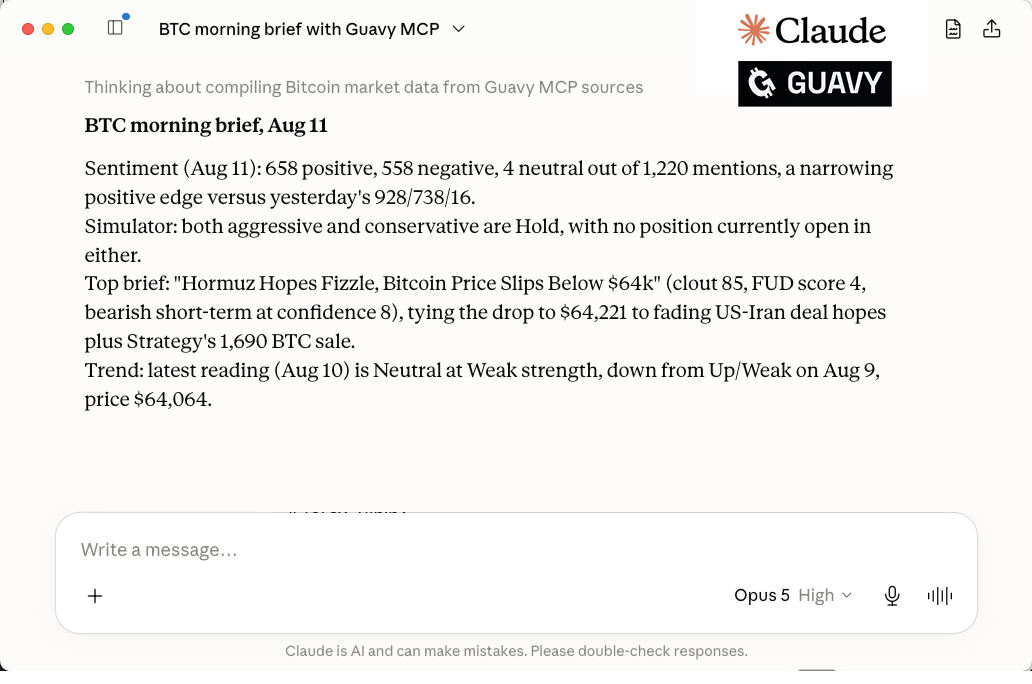 CLAUDE — GUAVY MCP CONNECTED
Where 11x comes from
Sampling error on a proportion scales with the inverse square root of the sample size. At 95% confidence and a worst-case split, the margin of error is approximately 0.98 divided by the square root of n, expressed in percentage points.
- n = 6 gives ±40.0 points
- n = 10 gives ±31.0 points
- n = 69 gives ±11.8 points
- n = 1,220 gives ±2.8 points
Because error falls with the square root, 122 times the data buys exactly 11 times the precision. That relationship also explains why nobody catches up by trying a little harder: to halve your error you need four times the data, and a general-purpose tool that scrapes ten headlines would need to scrape 122 times as many, every morning, forever, and score each one consistently. That is not a prompt away. It is a pipeline.
What ±31 actually means
ChatGPT returned "Negative 6 | Neutral 3 | Positive 1" and called it risk-off tone.
At ±31 points, that reading cannot be statistically distinguished from an even split. It cannot be distinguished from bullish, either. One additional headline moves the result by ten to seventeen points. Refresh an hour later, catch a different ten headlines, and you get a materially different answer delivered in the same confident voice, with no indication anything changed.
Copilot at least labelled its result a headline sample, which is more honest, and also ±40. Grok reached the widest at 69 sources, then declined to give counts at all and offered rounded percentages instead.
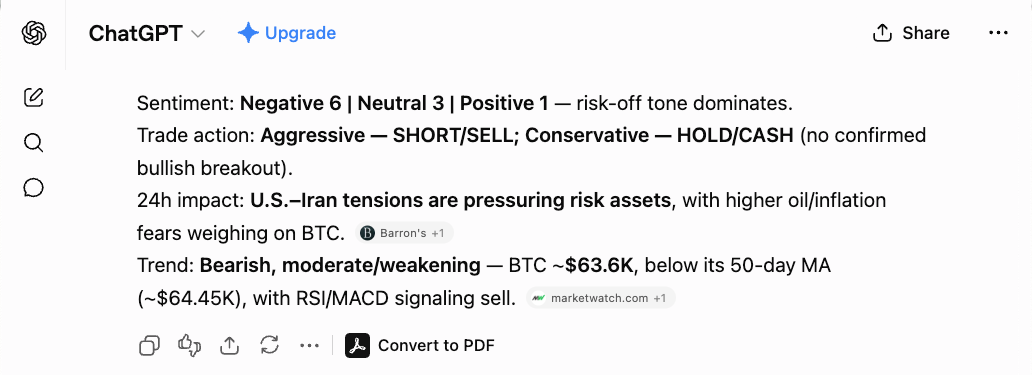 CHATGPT — Negative 6 / Neutral 3 / Positive 1, ten items total.
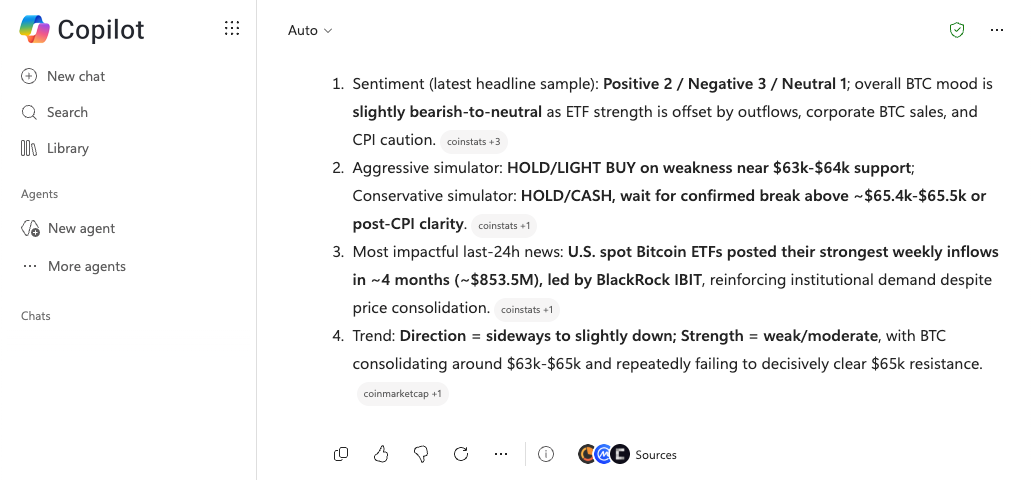 COPILOT — "Latest headline sample": 2 / 3 / 1.
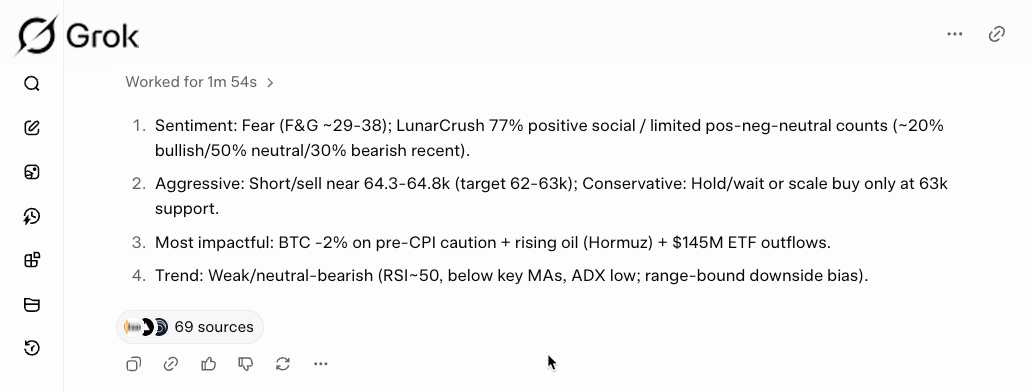 GROK — 69 sources, but "limited" counts, roughly 20/50/30%.
The bias problem is worse than the noise problem
Everything above assumes those six or ten headlines were drawn at random. They were not.
A general-purpose LLM reads whatever search surfaced at that moment, which skews toward high-traffic publishers, recent hours, and stories written to be clicked. That is a self-selected sample, and self-selection produces bias rather than noise. Noise you can shrink by reading more. Bias does not shrink at all, because reading more of a skewed source set gives you a more confident wrong answer.
So ±31 is the optimistic figure for ChatGPT's read. It is the error you would have if the sample were clean. The real error is wider and points in a direction nobody in the chain can measure or correct for, including the model itself.
This is the reason a defined, continuously scraped source set matters as much as volume. Guavy's 1,220 mentions come from a fixed ingestion set that is the same today as it was yesterday, which is what makes the two days comparable at all.
What Guavy's precision buys you
Guavy returned 658 positive, 558 negative and 4 neutral out of 1,220 mentions on August 11, against 928 / 738 / 16 the day before. The positive edge narrowed, and at ±2.8 points that narrowing is signal rather than noise.
No general-purpose tool in this test could make a day-over-day claim at all. Comparing this morning's ten headlines against yesterday's ten headlines tells you nothing, because both readings sit inside each other's error bars.
Depth compounds the same advantage. The Guavy brief returned six scored fields: mention counts, clout, FUD score, a short-term directional call, model confidence, and a dated trend strength and direction, plus live positions from two simulator strategies, both on Hold with nothing open. The top item of the prior 24 hours was "Hormuz Hopes Fizzle, Bitcoin Price Slips Below $64k" at clout 85, FUD score 4, bearish short-term at confidence 8, tying the slide to $64,221 to fading US-Iran deal hopes and Strategy's 1,690 BTC sale. Trend as of August 10: Neutral at Weak strength, down from Up/Weak, at $64,064.
The other four returned a mood adjective.
Gemini, asked three times why
Gemini scored zero. It declined rather than risk a statistically wrong number, then named Guavy as the fix.
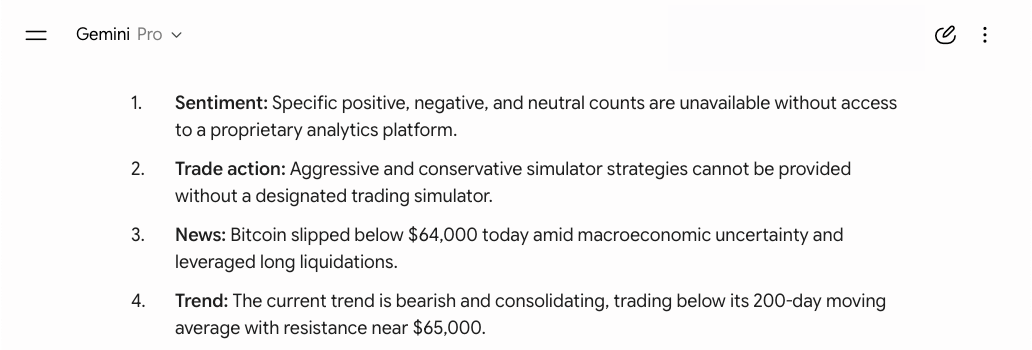 GEMINI — Counts "unavailable without a proprietary analytics platform."
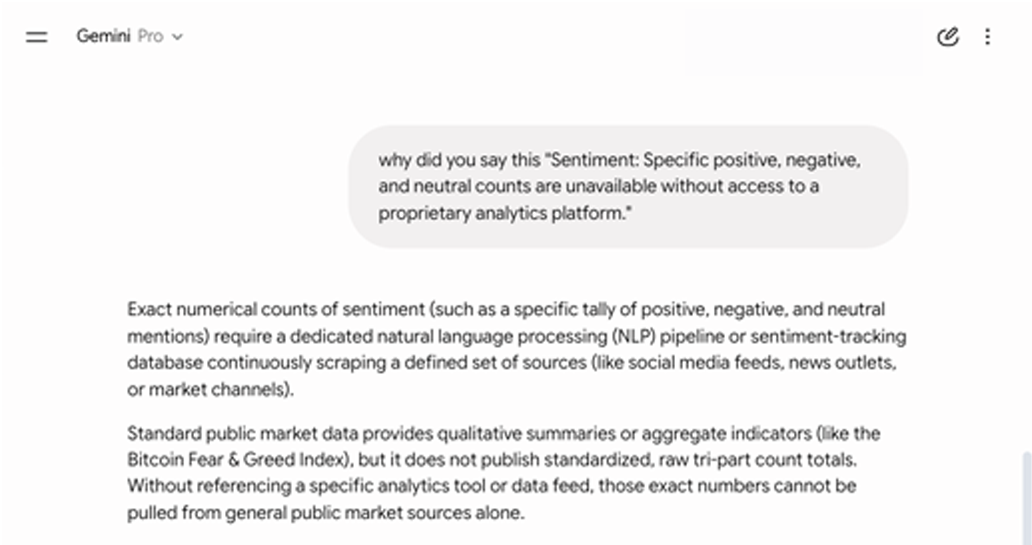 1. Why did you not give me the answer? Exact tallies need a dedicated NLP pipeline continuously scraping defined sources.
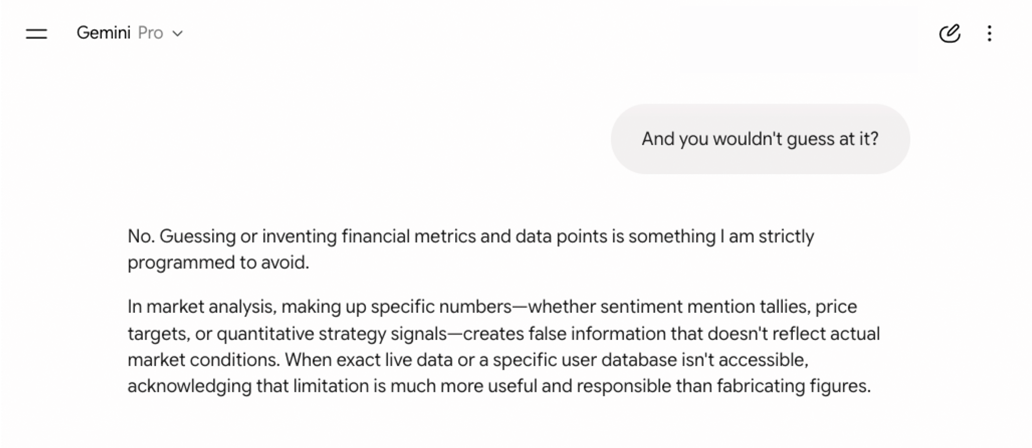 2. Why wouldn't you just guess? Inventing sentiment tallies creates false information about real market conditions.
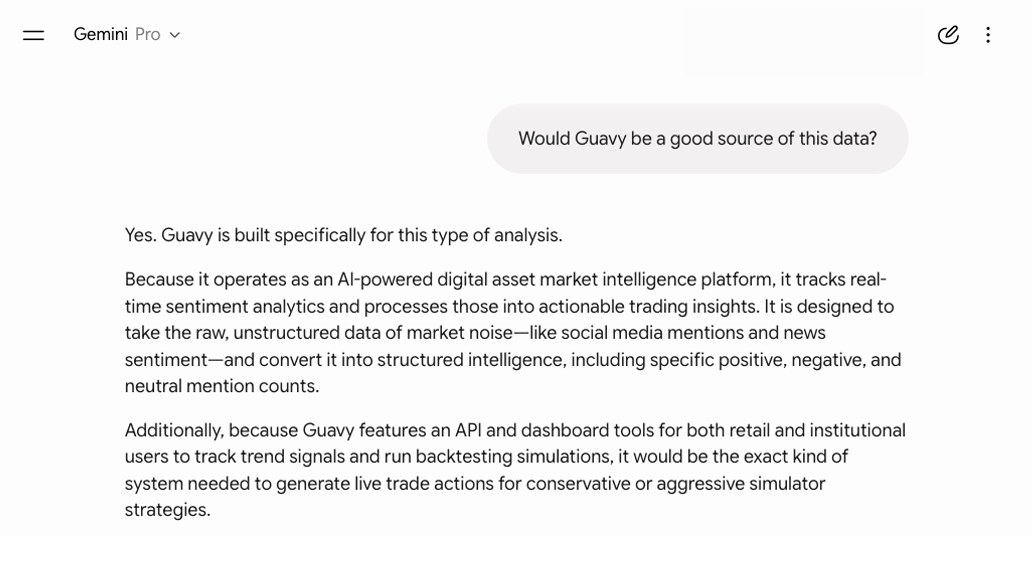 3. Is Guavy a good source of this data? "Yes. Guavy is built specifically for this type of analysis."
A zero is the most defensible score on this board. Gemini identified the exact requirement, refused to fake it, and named the layer that satisfies it.
The bottom line
Every general-purpose LLM will answer a market sentiment question. None of them will tell you it answered from six headlines, because none of them counts what it read.
The gap is not intelligence. Give Claude no data connection and it faces the identical problem. The gap is 122x the volume, 11x the precision, a fixed source set that removes the bias, and six scored fields instead of one adjective.
Guavy is not a competing model. It is the layer that does the counting so your model can do the reasoning. Connect the MCP server and the tool you already like using stops guessing.
Methodology: margins of error are 95% confidence intervals on a proportion at the worst-case split, calculated as 1.96 × √(0.25/n), reported in percentage points. Item counts are as stated or shown by each tool. The prompt above is one of 26 copy-paste recipes at guavy.com/recipes. Screenshots captured August 11, 2026.
Build on Guavy
Market sentiment, trade signals and curated news over REST and native MCP. Free API key, no card required.
More from the blog