
Not All Crypto News Is Equal. Guavy's New Article Metadata Can Tell You Why.
PRODUCT ANNOUNCEMENT
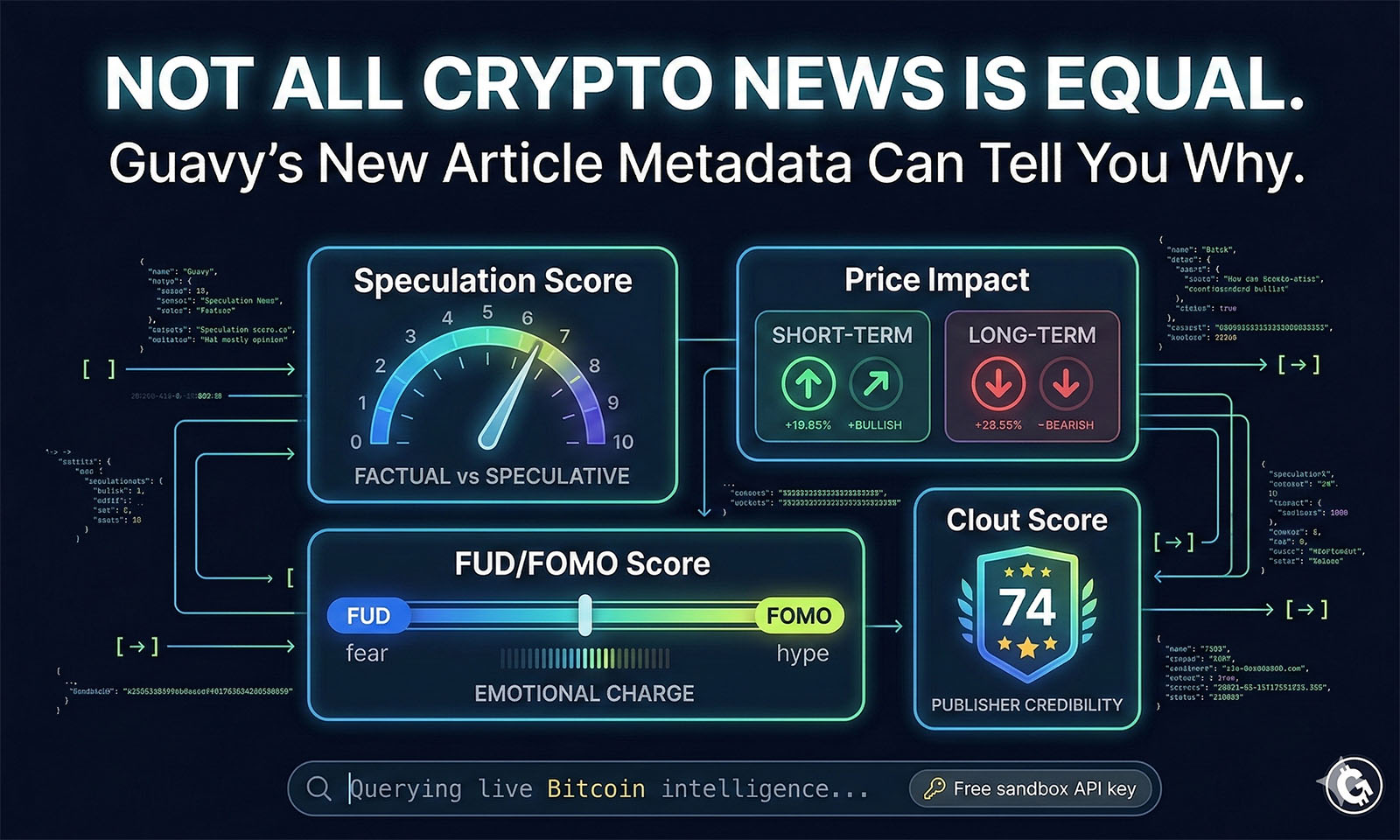
Every article flowing through the Guavy API now carries four new metadata dimensions: Speculation Score, Impacted Coins, FUD/FOMO Score, and Clout Score. In addition to our existing sentiment score, together they give developers and analysts the context to know not just what the news says, but how much to trust it, how emotionally charged it is, and what it might mean for price trends.
Availability
All four Article Metadata dimensions are live in the Guavy API today. Existing endpoints are fully backward compatible and the new fields are additive. No breaking changes.
New to Guavy? Get your free sandbox API key and start querying live crypto intelligence across 300+ coins in minutes. Find out more at data.guavy.com. Full documentation is available at data.guavy.com/doc/getting-started.
Why Sentiment Alone Is Not Enough
Consider two articles, both scored as "bullish" by a standard sentiment model:
"Coinbase reports record Q3 revenue, up 42% year-over-year"
"Analysts predict Bitcoin will 10x by year-end based on historical cycles"
One is a verified financial result. The other is a forecast dressed up as insight. Feeding both equally into a trading system or market dashboard produces noise.
This is the fundamental problem with blunt tools like the Crypto Fear and Greed Index: a single composite score cannot tell you whether the fear is warranted.
A single bearish article is a data point. 50 bearish articles published within 6 hours is a signal. Thousands of articles are published hourly. There is volume and velocity. Which ones have the most clout, and when that volume is accelerating, it becomes an urgent signal. The raw sentiment integer of the Fear and Greed Index tells you nothing about either.
Guavy's new API article metadata dimensions exist to give your simulator and trading models the full picture.
The Four New Crypto Article Metadata Dimensions
1. Speculation Score
API documentation: /doc/get-article, /doc/get-recent-briefs
What it measures
How much of an article is opinion, prediction, or unverified assertion versus reported, confirmed fact.
Scale: 0 to 10
| Score | Meaning |
|---|---|
| 0 to 2 | Factual reporting: verified events, official statements, confirmed data |
| 3 to 4 | Mostly factual with some analyst opinion mixed in |
| 5 to 6 | Roughly half fact, half prediction or unverified claims |
| 7 to 8 | Mostly opinion, forecasts, or unverified assertions |
| 9 to 10 | Pure speculation with no factual basis |
API field: speculation_score (integer, 0 to 10)
Use case for developers
Filter or weight your ingested articles before passing sentiment downstream. A trading signal built on articles with a speculation score of 2 is categorically more reliable than one built on articles scoring 8. Enforce that threshold programmatically.
Use case for analysts
Surface only high-confidence, fact-based reporting in your dashboards, or track when speculation spikes around a specific asset as a leading indicator of volatility.
2. Impacted Coins
API documentation: /doc/get-article, /doc/get-recent-briefs
What it measures
For each asset mentioned in an article, the predicted directional effect on price (bullish, bearish, or neutral) along with a confidence score and timeframe.
API fields
| API Field | Type | Description |
|---|---|---|
impacted_coins[].asset |
string | Ticker symbol of the referenced coin (e.g., BTC, ETH) |
impacted_coins[].direction |
string | Predicted direction: bullish, bearish, or neutral |
impacted_coins[].confidence |
integer | The scoring model's confidence in this directional call, from 1 (low) to 10 (high) |
impacted_coins[].timeframe |
string | Horizon of the predicted move: "short" (hours to days) or "long" (weeks to months) |
Why the timeframe matters
Regulatory news is a classic example where short-term and long-term signals diverge sharply. An SEC enforcement action against an exchange reads as bearish in the short term. For analysts who see regulatory clarity as bullish for institutional adoption long-term, the same news can point the other way. Each impacted coin carries one timeframe, which says whether its predicted direction applies to the short term (hours to days) or the long term (weeks to months).
Use case for developers
Aggregate directional signals across multiple articles per asset to build a real-time price pressure index. Weight by confidence score to reduce noise from low-certainty predictions. Filter by timeframe to align with your trading horizon.
Use case for analysts
Identify when short-term and long-term outlooks differ across articles. That divergence is a reliable marker of market uncertainty and potential volatility ahead.
3. FUD/FOMO Score
API documentation: /doc/get-article, /doc/get-recent-briefs
What it measures
The emotional charge of an article's language: how manipulative or fear/hype-driven the framing is, and in which direction. This dimension returns two values.
fud_fomo_bias (direction)
| Value | Meaning |
|---|---|
| neutral | Balanced or factual, no dominant emotional direction |
| fud | Fear, Uncertainty, Doubt: doom framing, panic language, "crypto is dead" style |
| fomo | Fear Of Missing Out: hype, moon talk, urgency to buy, "don't miss this" style |
fud_fomo_score (intensity, 0 to 10)
| Score | Meaning |
|---|---|
| 0 to 2 | Neutral/factual: dry, balanced, no emotional framing |
| 3 to 4 | Mildly loaded: some emotive language but mostly measured |
| 5 to 6 | Noticeably biased: framing designed to provoke a reaction |
| 7 to 8 | Heavy emotional language: sensationalized headlines, urgency |
| 9 to 10 | Pure manipulation with almost no factual content |
API fields: fud_fomo_bias (string: neutral | fud | fomo), fud_fomo_score (integer, 0 to 10)
Use case for developers
Filter out high-FUD/FOMO content from feeds where you need clean data. Alternatively, track fud_fomo_score as its own signal. Extreme readings in either direction historically correlate with market inflection points.
Use case for analysts
Build a real-time emotional temperature gauge for any asset or market segment. When FOMO scores spike across multiple sources simultaneously, that becomes a measurable signal rather than a gut feeling.
4. Clout Score
API documentation: /doc/get-article, /doc/get-recent-briefs
What it measures
The credibility and reach of the publisher behind an article. Clout is scored between 0 and 100, reflecting the publisher's audience size, credibility, and trust as assessed by Guavy.
API field: clout (integer, 0 to 100)
Why it matters
Sentiment scores from a high-clout publisher carry meaningfully different market weight than the same score from an obscure or low-trust source. A bearish article from a major institutional outlet is not the same signal as a bearish article from an anonymous blog, even if the sentiment integer is identical. Clout lets you treat them differently.
Use case for developers
Use clout as a weighting coefficient when aggregating sentiment across articles. A clout-weighted sentiment average is significantly more noise-resistant than a simple average. Consider applying a minimum clout threshold to filter low-trust noise from your feeds.
Use case for analysts
Sort your newswire by clout score to surface the articles most likely to carry genuine price-moving signal. A low-clout, high-FOMO article is a categorically different data point from a high-clout, low-speculation article, even when both carry the same bullish sentiment label.
What a Full Article Response Now Looks Like
{
  "article_id": "abc123",
  "title": "Bitcoin ETF Sees Record Inflows",
  "body": "...",
  "date": "2026-03-05",
  "timestamp": 1741132800000,
  "symbols": ["BTC", "ETH"],
  "tone": "optimistic",
  "sentiment": 3,
  "clout": 74,
  "speculation_score": 7,
  "fud_fomo_score": 6,
  "fud_fomo_bias": "fomo",
  "impacted_coins": [
    {
      "asset": "BTC",
      "direction": "bullish",
      "confidence": 8,
      "timeframe": "short"
    },
    {
      "asset": "ETH",
      "direction": "neutral",
      "confidence": 5,
      "timeframe": "long"
    }
  ]
}
In one response, you now know: the article is bullish, published by a credible source, but the underlying content is mostly speculative, the FOMO framing is noticeable, and it points short-term bullish on BTC with high confidence. That is the kind of context a flat sentiment score cannot provide.
Get Started
All four Article Metadata dimensions are live today. Get your free sandbox API key and start querying live crypto intelligence in minutes.
Full API reference: data.guavy.com/doc/getting-started
Build on Guavy
Market sentiment, trade signals and curated news over REST and native MCP. Free API key, no card required.
More from the blog